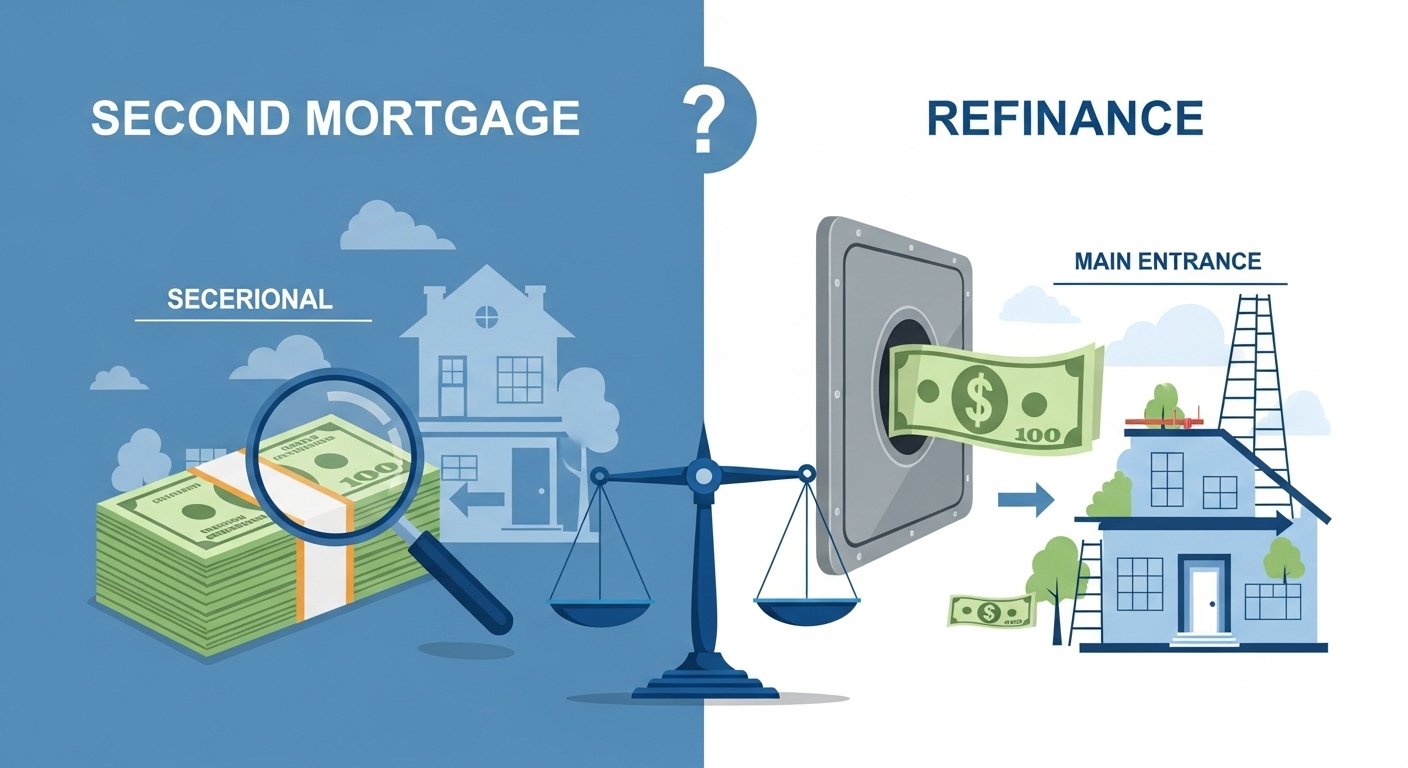
When you need to access your home equity — whether for a renovation, debt consolidation, or a major expense — two of the most common options are taking out a second mortgage or doing a cash-out refinance. Both let you tap the equity you have built, but they work very differently and the right choice depends heavily on your current interest rate, how much equity you need, and your long-term plans.
This guide compares second mortgages and cash-out refinancing side by side — covering rates, costs, risks, and the specific scenarios where each option makes the most financial sense.
Key Takeaways
- A second mortgage adds a new loan on top of your existing mortgage without changing it.
- A cash-out refinance replaces your entire mortgage with a new, larger loan.
- If your current rate is low, a second mortgage preserves it — refinancing would replace it.
- Cash-out refinancing typically offers lower rates than second mortgages.
- Both options use your home as collateral and carry foreclosure risk if unpaid.
What Is a Second Mortgage?
A second mortgage is an additional loan taken out against your home equity while your original mortgage remains in place. It is called a “second” mortgage because it is subordinate to your first mortgage — meaning in a foreclosure, the first mortgage lender gets paid before the second. Second mortgages come in two forms: home equity loans (lump sum, fixed rate) and HELOCs (revolving line of credit, usually variable rate).
What Is a Cash-Out Refinance?
A cash-out refinance replaces your existing mortgage with a new, larger loan. The difference between the new loan amount and your current balance is paid to you in cash at closing. For example, if you owe $200,000 on a home worth $400,000 and refinance into a $280,000 loan, you receive $80,000 in cash. Your original mortgage is paid off and replaced entirely.
Side-by-Side Comparison
| Feature | Second Mortgage | Cash-Out Refinance |
|---|---|---|
| Effect on first mortgage | Unchanged — kept in place | Replaced with new loan |
| Interest rate | Higher (second lien risk) | Lower (first lien position) |
| Monthly payments | Two separate payments | One combined payment |
| Closing costs | Lower ($500 – $3,000) | Higher (2% – 5% of loan) |
| Best when current rate is | Low — preserve it | High — replace it |
| Loan term impact | No change to first mortgage term | Resets loan term |
| Tax deductibility | Interest may be deductible if used for home improvement | Interest may be deductible on home improvement portion |
When a Second Mortgage Makes More Sense
A second mortgage is the better choice when your current first mortgage has a low interest rate that you do not want to give up. If you locked in a 3% rate in 2021 and current rates are 7%, doing a cash-out refinance would mean replacing your entire loan balance at the higher rate — dramatically increasing your monthly payment and total interest cost. A second mortgage lets you access equity without disturbing your favorable first mortgage.
When a Cash-Out Refinance Makes More Sense
A cash-out refinance is the better choice when your current mortgage rate is at or above current market rates, meaning you can lower your rate while also accessing equity. It is also preferable when you want a single, simplified monthly payment rather than managing two separate loans. The lower interest rate on a cash-out refinance (compared to a second mortgage) can also make it cheaper over the long term despite the higher closing costs.
“The single most important factor in this decision is your current mortgage rate. If it is below today’s market rate, protect it with a second mortgage. If it is above, a cash-out refinance may save you money on both fronts.” — Mortgage Strategist
The Rate Trap: A Real-World Example
Consider a homeowner with a $300,000 mortgage at 3.5% who needs $75,000 for a home renovation. Current rates are 7%.
- Cash-out refinance: New loan of $375,000 at 7% — monthly payment jumps from $1,347 to $2,495. Total interest over 30 years: $523,000.
- Second mortgage (home equity loan): Keep $300,000 at 3.5% + new $75,000 loan at 8.5% — combined payment of approximately $1,347 + $578 = $1,925. Total interest significantly lower.
In this scenario, the second mortgage saves the homeowner over $570 per month and hundreds of thousands in total interest.
FAQ
Is a second mortgage the same as a home equity loan?
Yes. A home equity loan is a type of second mortgage — it is a lump-sum loan secured by your home equity that sits behind your first mortgage. A HELOC (home equity line of credit) is also a second mortgage, but it works as a revolving line of credit rather than a fixed lump sum. Both are subordinate to your first mortgage in terms of repayment priority.
Which has lower interest rates — a second mortgage or a cash-out refinance?
Cash-out refinances typically offer lower interest rates than second mortgages because they are in first lien position — meaning the lender has priority claim on the property in a foreclosure. Second mortgages carry higher rates to compensate for the additional risk of being in second position. However, the lower rate on a cash-out refinance only benefits you if it applies to your entire loan balance, not just the cash-out portion.
Can I have both a first mortgage and a second mortgage at the same time?
Yes. Having both a first and second mortgage simultaneously is common and perfectly legal. Your combined loan-to-value ratio (both loans together divided by the home’s value) must stay within the lender’s limits — typically 80% to 85%. You will make two separate monthly payments to potentially two different servicers.
Does a cash-out refinance reset my mortgage term?
Yes. A cash-out refinance replaces your existing mortgage with a new loan, which typically starts a new 30-year (or 15-year) term. If you have been paying your mortgage for 10 years and refinance into a new 30-year loan, you are extending your total repayment timeline. This is an important consideration — the lower monthly payment may come at the cost of paying interest for many more years.