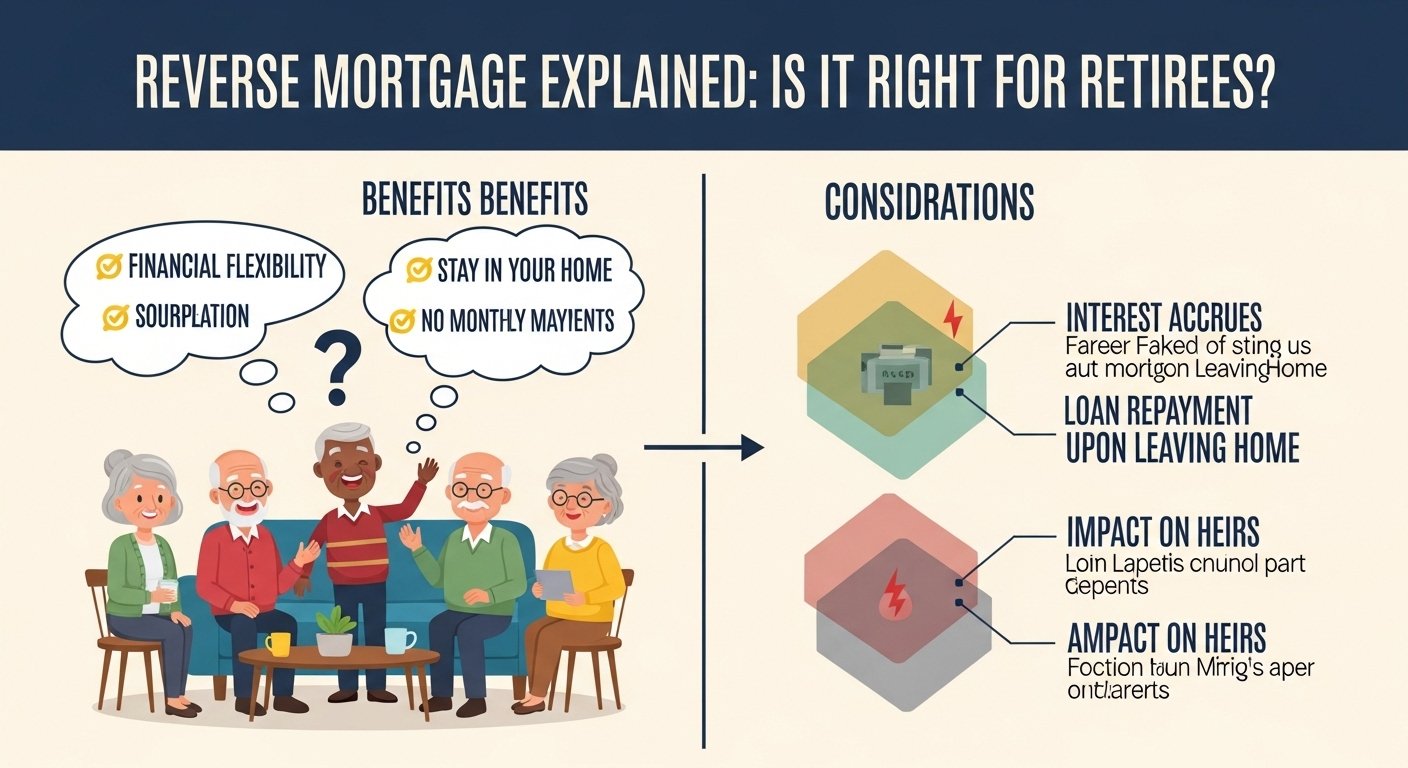
For homeowners aged 62 and older, a reverse mortgage offers a way to convert home equity into tax-free income without selling the home or making monthly mortgage payments. It sounds like an ideal retirement solution — but reverse mortgages are complex financial products with significant costs and risks that every retiree should fully understand before signing.
This guide provides a clear, unbiased explanation of how reverse mortgages work, who qualifies, how much you can borrow, what the real costs are, and the situations where a reverse mortgage makes sense — and where it does not.
Key Takeaways
- A reverse mortgage lets homeowners 62+ borrow against their home equity with no monthly payments required.
- The loan balance grows over time as interest accrues — it is repaid when you sell, move out, or pass away.
- The most common type is the FHA-insured Home Equity Conversion Mortgage (HECM).
- You must continue paying property taxes, homeowners insurance, and maintenance costs.
- Heirs can repay the loan and keep the home, or sell the home to settle the balance.
How a Reverse Mortgage Works
Unlike a traditional mortgage where you make monthly payments to the lender, a reverse mortgage works in the opposite direction — the lender makes payments to you, or provides a lump sum or line of credit, based on your home equity. No monthly mortgage payment is required. Instead, the loan balance grows over time as interest accrues, and the full balance becomes due when you sell the home, permanently move out, or pass away.
The most common reverse mortgage is the Home Equity Conversion Mortgage (HECM), which is insured by the FHA and regulated by the federal government. HECMs account for the vast majority of reverse mortgages in the United States.
Reverse Mortgage Eligibility Requirements
- At least one borrower must be 62 years of age or older
- The home must be your primary residence
- You must have significant equity in the home (typically 50% or more)
- The home must meet FHA property standards
- You must complete a HUD-approved counseling session before applying
- You must be current on property taxes, homeowners insurance, and HOA fees
How Much Can You Borrow?
The amount you can borrow with a HECM depends on three factors: your age (older borrowers can access more equity), the home’s appraised value, and current interest rates. The maximum HECM loan limit in 2024 is $1,149,825. The table below shows approximate borrowing amounts based on age and home value.
| Age | Home Value $300,000 | Home Value $500,000 | Home Value $750,000 |
|---|---|---|---|
| 62 | ~$150,000 | ~$250,000 | ~$375,000 |
| 70 | ~$168,000 | ~$280,000 | ~$420,000 |
| 75 | ~$180,000 | ~$300,000 | ~$450,000 |
| 80 | ~$195,000 | ~$325,000 | ~$487,000 |
Payment Options for Reverse Mortgages
Borrowers can receive reverse mortgage proceeds in several ways, depending on their financial needs.
- Lump sum: Receive all available funds at closing (only option with a fixed rate)
- Monthly payments: Receive equal monthly payments for a set term or for as long as you live in the home
- Line of credit: Draw funds as needed — the unused portion grows over time
- Combination: Mix of monthly payments and a line of credit
The Real Costs of a Reverse Mortgage
Reverse mortgages are expensive. Upfront costs include an FHA mortgage insurance premium of 2% of the home’s appraised value, origination fees up to $6,000, and standard closing costs. Interest accrues on the growing loan balance over time, which can significantly erode the equity available to heirs.
“A reverse mortgage can be a powerful tool for the right retiree — but it is not free money. The costs are real, and the impact on your estate can be substantial. Go in with eyes open.” — Certified Financial Planner, Retirement Specialist
When a Reverse Mortgage Makes Sense
A reverse mortgage is most appropriate for retirees who plan to stay in their home long-term, have limited retirement income but significant home equity, do not plan to leave the home to heirs, and have exhausted other retirement income options. It is least appropriate for those who may need to move within a few years, want to preserve equity for heirs, or have other affordable borrowing options available.
FAQ
Do I have to make monthly payments on a reverse mortgage?
No monthly mortgage payments are required on a reverse mortgage. However, you must continue paying property taxes, homeowners insurance, and any HOA fees. Failure to keep up with these obligations can trigger a default and potentially foreclosure, even on a reverse mortgage. The loan balance grows over time as interest accrues and becomes due when you sell, move out permanently, or pass away.
What happens to a reverse mortgage when the homeowner dies?
When the last borrower passes away, the loan becomes due. Heirs typically have 6 to 12 months to decide what to do. They can repay the loan balance and keep the home, sell the home and use the proceeds to repay the loan (keeping any remaining equity), or walk away if the loan balance exceeds the home’s value — FHA insurance covers the shortfall, so heirs are never personally liable for more than the home is worth.
Is reverse mortgage income taxable?
No. Reverse mortgage proceeds are considered loan advances, not income, so they are not subject to federal income tax. They also do not affect Social Security or Medicare benefits. However, they may affect eligibility for need-based programs like Medicaid if the funds are not spent in the month received. Consult a financial advisor or tax professional for guidance specific to your situation.
Can I lose my home with a reverse mortgage?
Yes, in certain circumstances. While you cannot be foreclosed on for not making mortgage payments, you can lose your home if you fail to pay property taxes, homeowners insurance, or HOA fees, or if you stop using the home as your primary residence for more than 12 consecutive months. Maintaining these obligations is a condition of the reverse mortgage agreement.