Most homebuyers assume every mortgage payment chips away at what they owe. But with an interest-only mortgage, that is not the case — at least not at first. During the interest-only period, your entire monthly payment goes toward interest, and your loan balance stays exactly the same. It sounds counterintuitive, but for the right borrower in the right situation, this structure can be a powerful financial tool.
Interest-only loans are not for everyone — and they carry real risks if misused. But dismissing them entirely means missing a legitimate strategy used by high-income earners, real estate investors, and buyers in high-cost markets. This guide explains exactly how interest-only mortgages work, who they benefit, and what the dangers are so you can make an informed decision.
Key Takeaways
- During the interest-only period, you pay only interest — your loan balance does not decrease.
- Interest-only periods typically last 5 to 10 years, after which payments reset to fully amortizing.
- Monthly payments jump significantly when the interest-only period ends.
- These loans work best for high-income earners with variable income or short-term ownership plans.
- Interest-only mortgages carry higher risk and are harder to qualify for than conventional loans.
How an Interest-Only Mortgage Works
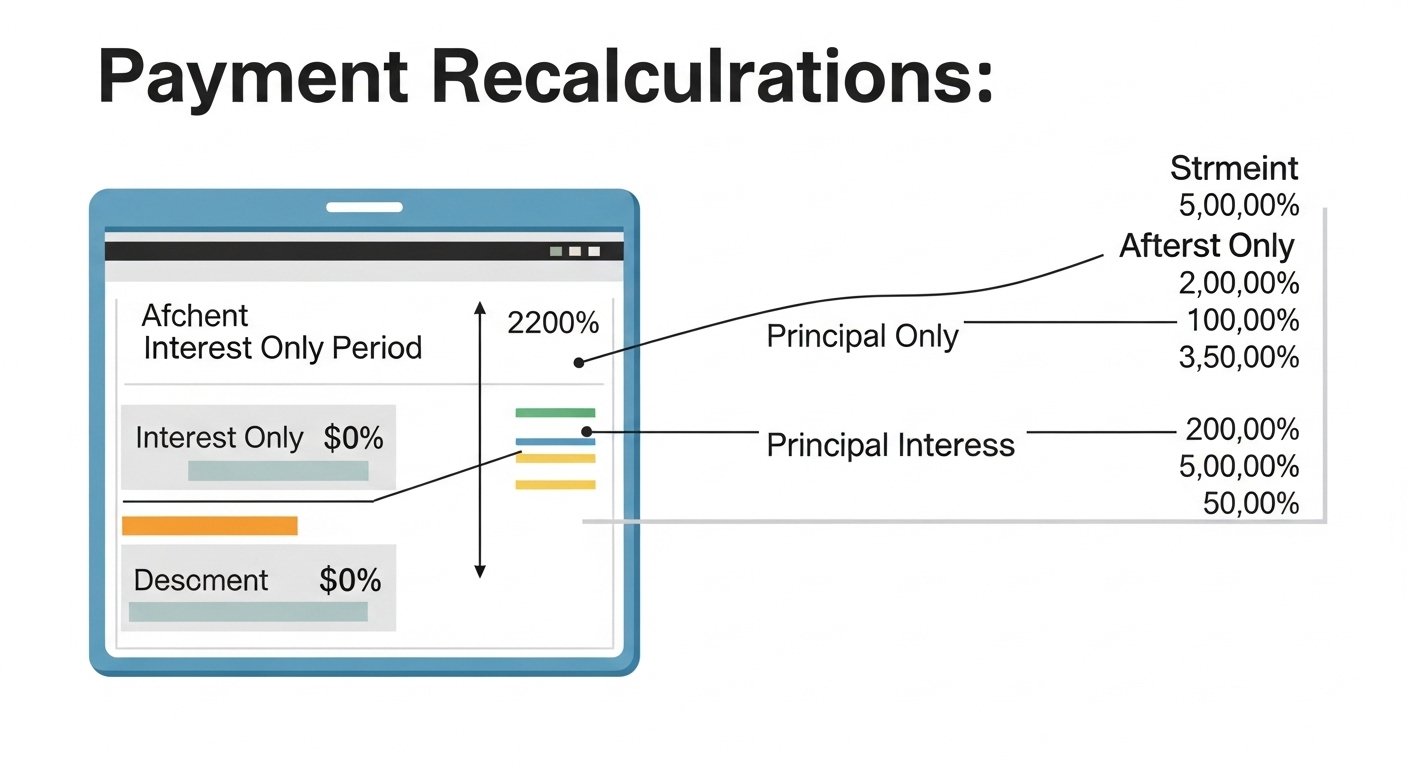
An interest-only mortgage is structured in two phases. During the first phase — the interest-only period — your monthly payment covers only the interest accruing on the loan. Your principal balance does not decrease at all. This phase typically lasts 5, 7, or 10 years.
When the interest-only period ends, the loan converts to a fully amortizing payment. Now you must repay the entire original principal balance over the remaining loan term — which is shorter than a standard 30-year loan. This causes your monthly payment to increase substantially, sometimes by 30% to 60% or more.
Example: Payment Comparison on a $500,000 Loan at 7%
| Phase | Payment Type | Monthly Payment | Balance After Period |
|---|---|---|---|
| Years 1–10 (IO period) | Interest only | $2,917 | $500,000 (unchanged) |
| Years 11–30 (amortizing) | Principal + interest | $3,876 | Decreases to $0 |
| Standard 30-yr fixed at 7% | Principal + interest | $3,327 | Decreases to $0 |
Types of Interest-Only Mortgages
Interest-only loans come in two main structures, and understanding the difference is important before you apply.
Interest-Only ARM (Adjustable-Rate)
The most common type combines an interest-only period with an adjustable rate. For example, a 10/1 IO ARM has a fixed interest rate for 10 years (during which you pay only interest), then converts to an adjustable-rate fully amortizing loan. This structure carries two layers of risk: payment shock when the IO period ends, and rate risk when the ARM begins adjusting.
Interest-Only Fixed-Rate Mortgage
Less common but available through some lenders, a fixed-rate interest-only mortgage keeps the same interest rate throughout the loan while still having an initial IO period. Your rate will not change, but your payment will still jump significantly when the IO period ends and principal repayment begins. These are typically offered as jumbo loans to high-net-worth borrowers.
Who Should Consider an Interest-Only Mortgage?
Interest-only mortgages are not appropriate for most buyers. But there are specific situations where they make genuine financial sense.
High-Income Earners With Variable Income
Professionals who receive large annual bonuses — doctors, lawyers, investment bankers, commissioned salespeople — may benefit from lower required monthly payments during the IO period. They can make the minimum payment in lean months and apply bonus income directly to principal when cash flow allows. This flexibility can be more valuable than the forced savings of a standard amortizing loan.
Real Estate Investors
Investors who plan to hold a property for a short period, renovate and sell, or who prioritize cash flow over equity building may find interest-only loans attractive. Lower monthly payments improve cash-on-cash returns during the holding period. However, investors must be confident the property will appreciate enough to cover the unchanged loan balance at sale.
Buyers in High-Cost Markets Planning to Sell or Refinance
In markets like San Francisco, New York, or Seattle, home prices are so high that even high earners struggle with standard mortgage payments. An interest-only loan can make a home purchase feasible with the plan to refinance into a conventional loan once income grows or to sell before the IO period ends.
| Borrower Type | IO Mortgage Suitable? | Key Consideration |
|---|---|---|
| First-time buyer, average income | Generally no | Payment shock risk is too high |
| High-income, variable bonus earner | Yes, with discipline | Must apply bonuses to principal |
| Real estate investor (short hold) | Yes | Depends on appreciation and exit strategy |
| Buyer planning to sell in 5–7 years | Possibly | Must sell before IO period ends |
| Retiree on fixed income | No | Cannot absorb payment increase |
The Risks of Interest-Only Mortgages
The appeal of lower initial payments comes with serious risks that every borrower must understand before signing.
Payment Shock
When the interest-only period ends, your payment increases significantly — often by hundreds of dollars per month. If your income has not grown proportionally, this payment shock can strain your budget or even lead to default. Many borrowers who took IO loans before the 2008 financial crisis faced exactly this scenario when their payments reset.
No Equity Building During IO Period
Because you are not paying down principal, you build zero equity through your payments during the IO period. Your equity only grows if the property appreciates in value. If home prices fall, you could end up underwater — owing more than the home is worth — with no equity cushion to protect you.
“An interest-only mortgage is a sophisticated tool that requires a sophisticated borrower. Used correctly, it provides flexibility. Used carelessly, it is a path to financial trouble.” — Mortgage Banking Professional
How to Qualify for an Interest-Only Mortgage
Interest-only loans have stricter qualification requirements than conventional mortgages. Lenders know the risks and screen borrowers carefully.
- Most lenders require a credit score of 700 or higher — many prefer 720 or above.
- Down payments of 20% to 30% are typically required; some lenders require more for jumbo IO loans.
- Lenders qualify you based on the fully amortizing payment, not the lower IO payment, to ensure you can handle the reset.
- Significant cash reserves — often 12 to 24 months of payments — are commonly required.
- Debt-to-income ratios must be low, typically below 43%.
FAQ
Can I pay down principal during the interest-only period?
Yes — most interest-only mortgages allow you to make additional principal payments during the IO period without penalty. In fact, making voluntary principal payments during the IO period is one of the best strategies for managing the eventual payment reset. By reducing your balance before the amortizing phase begins, you lower the principal that must be repaid over the remaining term, which reduces the payment increase when the IO period ends.
Are interest-only mortgages still available after the 2008 financial crisis?
Yes, interest-only mortgages are still available, but they are far less common and have much stricter qualification requirements than before 2008. They are primarily offered as jumbo loans to high-net-worth borrowers through portfolio lenders and private banks. The loose IO lending that contributed to the housing crisis — with minimal documentation and low credit standards — has been largely eliminated by post-crisis regulations.
What happens if I cannot afford the higher payment when the IO period ends?
If you cannot afford the fully amortizing payment when the IO period ends, you have several options: refinance into a new loan (if you qualify and rates are favorable), sell the property, or contact your lender about a loan modification. However, none of these options are guaranteed. This is why financial advisors stress the importance of having a clear exit strategy before taking an interest-only loan — do not rely on being able to refinance or sell when the time comes.
Is the interest on an interest-only mortgage tax deductible?
Mortgage interest on a primary residence is generally deductible up to the limits set by current tax law — the same rules that apply to conventional mortgages. The fact that you are paying only interest during the IO period does not change the deductibility of that interest. However, tax laws change, and the benefit of the mortgage interest deduction depends on whether you itemize deductions. Consult a tax professional for advice specific to your situation.
How does an interest-only mortgage compare to renting?
During the IO period, an interest-only mortgage is somewhat similar to renting in that you are not building equity through your payments — you are simply paying for the right to occupy the property. The key difference is that you benefit from any property appreciation, and you have the stability of a fixed housing cost (if the rate is fixed). Whether IO ownership beats renting depends heavily on local home price appreciation, your tax situation, and how long you plan to stay in the home.