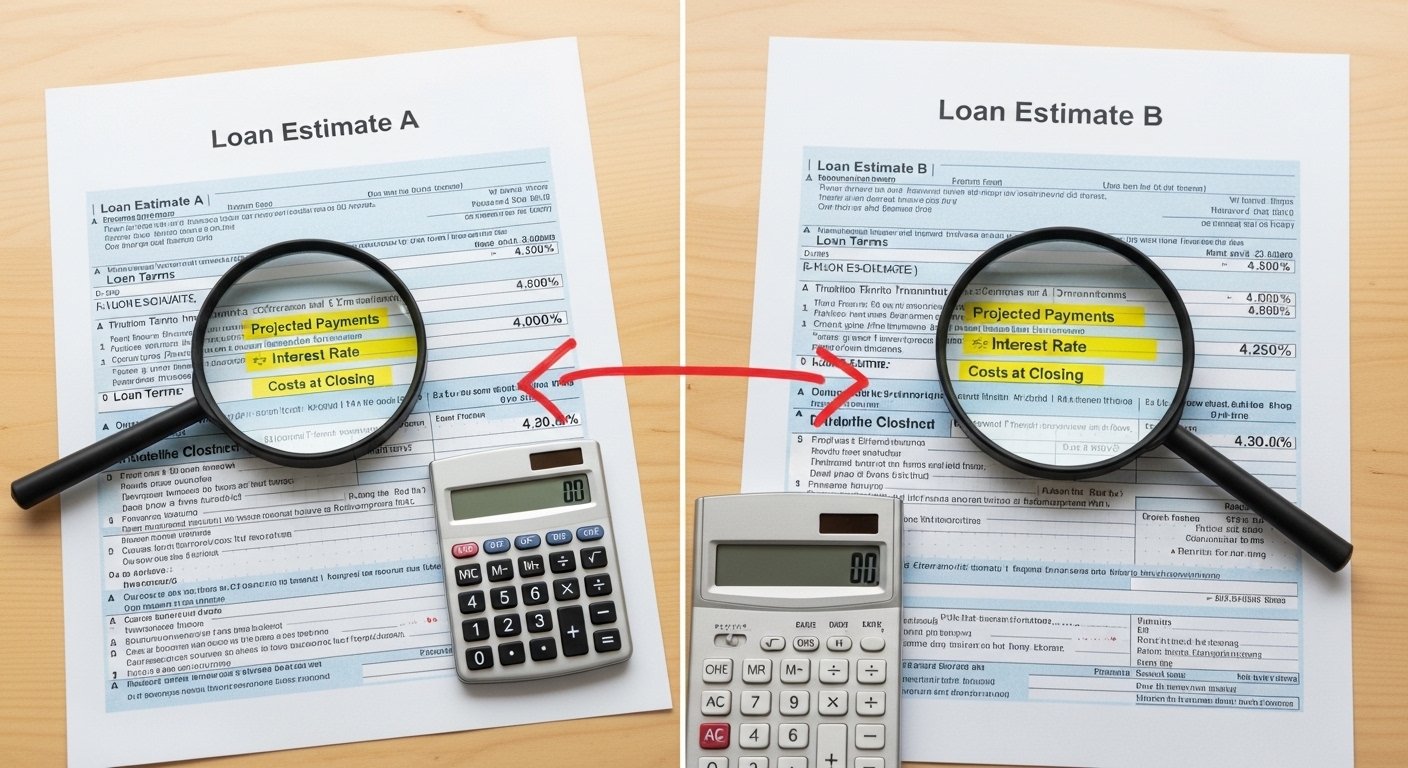
When you apply for a mortgage with multiple lenders, each one is required by federal law to give you a standardized three-page document called a Loan Estimate. This form was designed specifically to make it easy to compare offers apples-to-apples — but only if you know how to read it. Most borrowers glance at the interest rate and monthly payment, then stop. That is a costly mistake.
The Loan Estimate contains dozens of line items that can vary dramatically between lenders — and those differences can add up to thousands of dollars. This guide walks you through every section of the Loan Estimate and shows you exactly how to compare multiple offers so you can choose the mortgage that truly costs the least over time.
Key Takeaways
- Lenders must provide a Loan Estimate within three business days of receiving your application.
- The interest rate and APR are both important — APR reflects the true cost including fees.
- Closing costs are split into lender fees (negotiable) and third-party fees (less negotiable).
- The “In 5 Years” figure on page 3 is one of the best tools for comparing total loan cost.
- Always compare at least three Loan Estimates before choosing a lender.
What Is a Loan Estimate?
A Loan Estimate (LE) is a standardized three-page form required by the Consumer Financial Protection Bureau (CFPB) under the TRID rules. Every lender must provide it within three business days of receiving your mortgage application. Because the format is identical across all lenders, it is specifically designed to make side-by-side comparison straightforward.
The Loan Estimate replaced the older Good Faith Estimate (GFE) in 2015 and is far more transparent. It covers your loan terms, projected monthly payments, estimated closing costs, and important disclosures about rate adjustments, prepayment penalties, and balloon payments.
Page 1: Loan Terms and Projected Payments
The first page of the Loan Estimate contains the most critical numbers. Here is what to look at and what each item means.
Loan Terms Box
At the top right of page 1, you will find the Loan Terms box. This shows your loan amount, interest rate, monthly principal and interest payment, and whether any of these can increase after closing. Pay close attention to the “Can this amount increase after closing?” column — any “YES” here means you have a variable component that could raise your costs.
Projected Payments
Below the Loan Terms box is a breakdown of your estimated monthly payment, including principal and interest, mortgage insurance (if applicable), and estimated escrow for taxes and insurance. This is your total estimated monthly payment — the number you will actually write a check for each month. Compare this figure carefully across lenders, but do not stop here.
| Page 1 Section | What to Compare | Why It Matters |
|---|---|---|
| Interest Rate | The stated rate on the loan | Directly affects monthly payment |
| Monthly P&I | Principal + interest only | Core cost of borrowing |
| Estimated Total Payment | P&I + escrow + MI | Your actual monthly obligation |
| Prepayment Penalty | Yes or No | Avoid loans with penalties |
| Balloon Payment | Yes or No | Avoid unless you understand the risk |
Page 2: Closing Cost Details
Page 2 is where most of the variation between lenders lives. It breaks closing costs into two main categories: Section A (Origination Charges) and Sections B through H (Other Costs).
Section A: Origination Charges
These are fees charged directly by the lender — and they are fully negotiable. Origination charges include the loan origination fee, underwriting fee, and any discount points you are paying to buy down your rate. This is the section where lenders differ most. One lender might charge $3,000 in origination fees while another charges $500. Always ask lenders to reduce or waive origination fees, especially if you have strong credit.
Sections B and C: Services You Cannot and Can Shop For
Section B covers required services where the lender chooses the provider — like the appraisal and credit report. Section C covers services you can shop for independently, such as title insurance, settlement services, and pest inspections. Shopping for your own title company can save $200 to $500 or more compared to the lender’s default provider.
| Cost Category | Negotiable? | Typical Range |
|---|---|---|
| Origination fee | Yes — negotiate directly | 0% – 1% of loan amount |
| Underwriting fee | Sometimes | $400 – $900 |
| Appraisal fee | No (lender selects) | $400 – $700 |
| Title insurance (lender) | Shop around | $500 – $1,500 |
| Title insurance (owner) | Shop around | $500 – $1,500 |
| Settlement/closing fee | Shop around | $300 – $800 |
Page 3: Comparisons and What to Look For
Page 3 of the Loan Estimate contains the most powerful comparison tools — yet most borrowers never read it.
The “In 5 Years” Comparison
This section shows the total amount you will have paid (principal + interest + mortgage insurance + loan costs) in the first five years of the loan. It is one of the best single numbers for comparing two loans with different rates and fee structures. A loan with a lower rate but higher fees might actually cost more in the first five years than a loan with a slightly higher rate and lower fees.
Annual Percentage Rate (APR)
The APR reflects your interest rate plus most lender fees, expressed as a single annual percentage. It is always higher than the stated interest rate. When comparing two loans, the one with the lower APR is generally the better deal — but only if you plan to keep the loan long enough for the lower rate to offset any upfront costs. A loan with a lower APR but higher upfront fees may not be better if you plan to sell or refinance within a few years.
“The interest rate gets all the attention, but the APR and the ‘In 5 Years’ figure tell you what the loan actually costs. Those are the numbers that matter.” — Certified Mortgage Advisor
How to Compare Loan Estimates Side by Side
Once you have Loan Estimates from at least three lenders, use this systematic approach to find the best offer.
- Line up all three estimates and compare the interest rate and APR first.
- Compare Section A origination charges — then call the highest-fee lender and ask them to match the lowest.
- Check the “In 5 Years” total cost figure on page 3 of each estimate.
- Verify whether each loan has a prepayment penalty or balloon payment.
- Confirm the lock period offered — a 30-day lock on a complex transaction may not be enough.
- Ask each lender if they will provide a revised Loan Estimate after negotiating fees.
Common Mistakes When Comparing Loan Estimates
Even with a standardized form, borrowers make predictable errors when comparing offers. Avoid these pitfalls to make sure you are choosing the truly best loan.
Comparing Rates Quoted on Different Days
Mortgage rates change daily. If you received quotes from three lenders on three different days, you are not comparing the same market conditions. For a fair comparison, request quotes from all lenders on the same day — ideally within a few hours of each other.
Ignoring Discount Points
A lender offering a lower rate may be including discount points — prepaid interest that lowers your rate in exchange for an upfront fee. One point equals 1% of the loan amount. Make sure you are comparing loans with the same number of points, or calculate the break-even period to determine if buying points makes sense for your situation.
FAQ
How many Loan Estimates should I get before choosing a lender?
You should get at least three Loan Estimates, though five is even better. Research consistently shows that borrowers who compare multiple lenders save significantly — sometimes thousands of dollars — compared to those who go with the first lender they contact. The process of applying with multiple lenders within a 14 to 45-day window counts as a single credit inquiry for scoring purposes, so there is no credit score penalty for shopping around.
What is the difference between the interest rate and APR on a Loan Estimate?
The interest rate is the cost of borrowing the principal loan amount, expressed as a percentage. The APR (Annual Percentage Rate) includes the interest rate plus most lender fees — origination charges, mortgage broker fees, and certain other costs — spread over the life of the loan. The APR is always equal to or higher than the interest rate. When comparing loans, the APR gives you a more complete picture of the true cost of borrowing.
Can I negotiate the fees shown on a Loan Estimate?
Yes — especially the fees in Section A (Origination Charges). These are set by the lender and are fully negotiable. If one lender is offering lower origination fees, you can use that as leverage to ask another lender to match or beat it. Third-party fees in Sections B and C are less negotiable with the lender, but you can shop for your own providers for services like title insurance and settlement to reduce those costs.
What is the “In 5 Years” figure on page 3 of the Loan Estimate?
The “In 5 Years” figure shows the total amount you will have paid — including principal, interest, mortgage insurance, and loan costs — during the first five years of the loan. It is one of the most useful comparison tools on the Loan Estimate because it accounts for both the interest rate and the upfront fees. A loan with a lower rate but higher fees may actually cost more in the first five years than a loan with a slightly higher rate and lower fees.
Does applying with multiple lenders hurt my credit score?
No — not significantly. Credit scoring models treat multiple mortgage inquiries within a 14 to 45-day window as a single inquiry, recognizing that consumers shop for the best rate. This means you can apply with five lenders in the same week and it will have the same impact on your credit score as applying with just one. Do not let fear of credit score damage stop you from comparing multiple Loan Estimates.